By Market.us
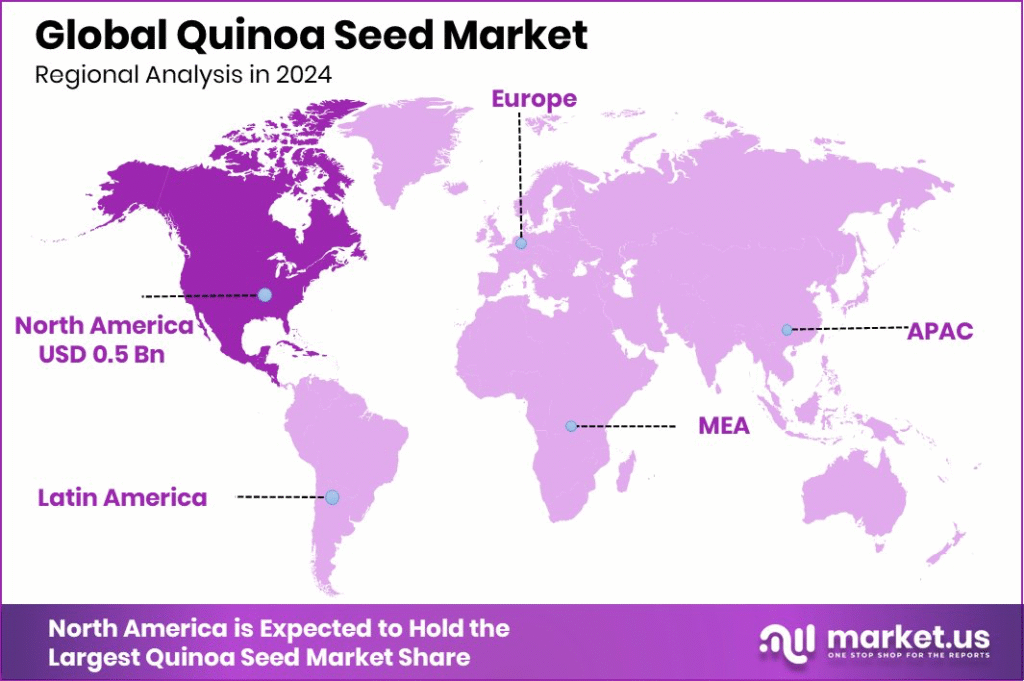
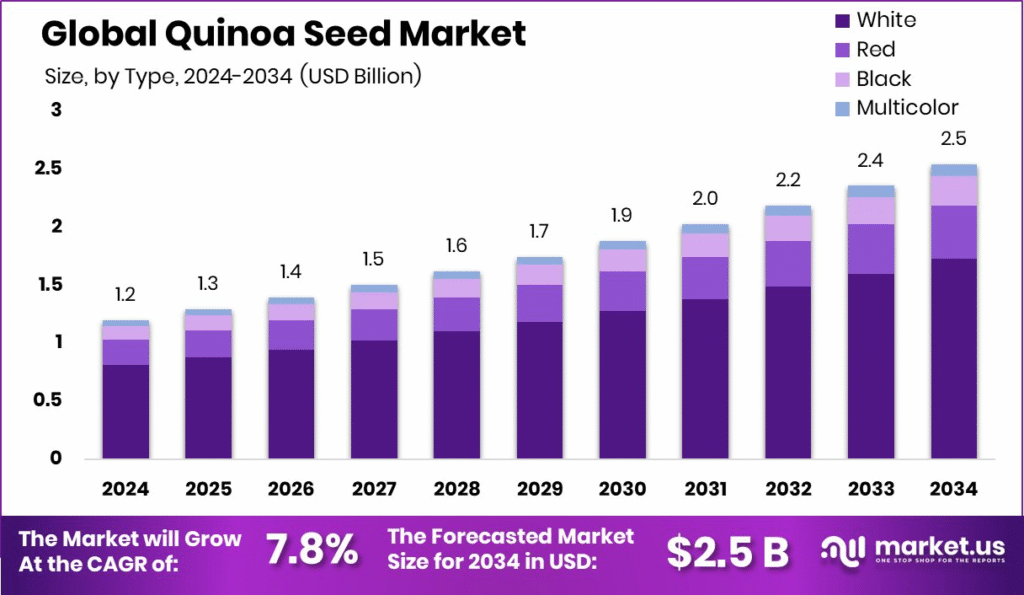
Global Quinoa Seed Market is expected to be worth around USD 2.5 billion by 2034, up from USD 1.2 billion in 2024, and grow at a CAGR of 7.8% from 2025 to 2034. With a 43.9% market share, North America reflects growing demand for plant-based protein alternatives.
Quinoa seed is a small, nutrient-dense grain-like seed that comes from the Chenopodium quinoa plant, traditionally cultivated in the Andean regions of South America. Despite often being used as a grain, it is technically a pseudocereal. It’s rich in protein, fiber, iron, magnesium, and all nine essential amino acids, making it a complete protein source that appeals to a wide range of dietary needs. Its gluten-free nature also makes it a valuable food option for those with gluten intolerance or celiac disease.
The quinoa seed market refers to the global trade and consumption of quinoa as a food product, encompassing raw seeds, processed foods, and value-added items derived from quinoa. This market has evolved rapidly over the past decade due to increasing consumer awareness of nutrition, shifting eating habits, and the growing trend toward plant-based diets.
One major growth factor for this market is the rising demand for superfoods that offer functional health benefits. Consumers are increasingly choosing quinoa as a versatile ingredient that supports weight management, boosts energy levels, and promotes digestive health. As health consciousness deepens globally, quinoa is being integrated into everything from breakfast bowls to baked snacks.
Demand has also surged due to changing lifestyles and urbanization, particularly in North America, Europe, and parts of Asia. More people are seeking convenient, healthy food options that require minimal preparation but offer maximum nutritional value—quinoa fits perfectly into this trend, driving higher retail availability and product innovation.
Key Takeaways
Global Quinoa Seed Market is expected to be worth around USD 2.5 billion by 2034, up from USD 1.2 billion in 2024, and grow at a CAGR of 7.8% from 2025 to 2034.
In 2024, white quinoa led the Quinoa Seed Market, capturing 67.9% of the type segment share.
The direct whole seed consumption application dominated, contributing 69.4% to the global Quinoa Seed Market in 2024.
In 2024, organic seed types held a significant position, accounting for 56.1% of overall quinoa sales.
Hypermarkets and supermarkets were the leading channels, securing a 56.3% share in Quinoa Seed Market distribution.
The North American quinoa seed industry reached USD 0.5 billion, driven by rising health-conscious consumers.
By Type Analysis
White quinoa dominates the Quinoa Seed Market with a 67.9% share globally.
In 2024, White held a dominant market position in the By Type segment of the Quinoa Seed Market, with a 67.9% share, driven by its widespread consumer acceptance, neutral taste profile, and versatile culinary applications. White quinoa remains the most preferred variety among health-conscious consumers and food processors due to its soft texture and quicker cooking time compared to red and black variants.
Its increasing use in salads, energy bars, plant-based meals, and gluten-free bakery items has expanded its appeal across retail and food service channels. Additionally, the surge in vegan and flexitarian lifestyles globally has supported the adoption of white quinoa as a complete protein source, further enhancing its market visibility.
The growing inclination toward organic and natural food products has also contributed to the higher demand for white quinoa seeds. This variety is commonly cultivated under sustainable agricultural practices, aligning with consumer trends toward clean-label and minimally processed foods.
By Application Analysis
Direct whole seed consumption leads with a 69.4% share of the market.
In 2024, Direct Whole Seed Consumption held a dominant market position in the By Application segment of the Quinoa Seed Market, with a 69.4% share, primarily driven by growing consumer preference for minimally processed and nutrient-dense food options.
Quinoa seeds, known for being rich in protein, fiber, and essential amino acids, have gained prominence as a superfood in both developed and emerging economies. The surge in home cooking trends, especially post-pandemic, has further encouraged the direct use of whole quinoa in salads, soups, breakfast bowls, and plant-based main courses.
Health-focused dietary habits, rising incidences of gluten intolerance, and the growing popularity of clean-label food products have positioned whole quinoa seeds as a staple in many modern diets.
Furthermore, the convenience of preparing whole quinoa and its adaptability across a wide range of cuisines—ranging from Latin American to Mediterranean and Asian fusion—has made it a go-to grain for consumers and chefs alike.
Regional Analysis
In 2024, North America led the Quinoa Seed Market with a 43.9% share, showcasing regional dominance.
In 2024, North America emerged as the leading region in the global quinoa seed market, accounting for a substantial 43.9% share and generating revenue of approximately USD 0.5 billion. The regional growth is fueled by increasing consumer demand for high-protein, gluten-free food alternatives and a strong presence of health-conscious populations in the United States and Canada.
Europe follows closely, driven by growing vegan and vegetarian trends, especially in countries like Germany, the UK, and France. The region benefits from well-established organic food distribution networks and a preference for sustainable farming practices, contributing to the market expansion.
In the Asia Pacific, the market is gaining momentum due to a shift in dietary preferences, rising disposable income, and urbanization, particularly in China, India, and Japan. However, the quinoa market in this region is still emerging and shows significant future potential.
The Middle East & Africa region is experiencing steady growth supported by expanding retail distribution and increasing adoption of health foods, especially in the UAE and South Africa. Meanwhile, Latin America, the native origin of quinoa, continues to play a critical role in cultivation and export, though domestic consumption remains limited compared to production.